
Strategy and decisions
Talent Engineering: From Fit-to-Standard to Permission to Perform
Este artículo está disponible por ahora en inglés.
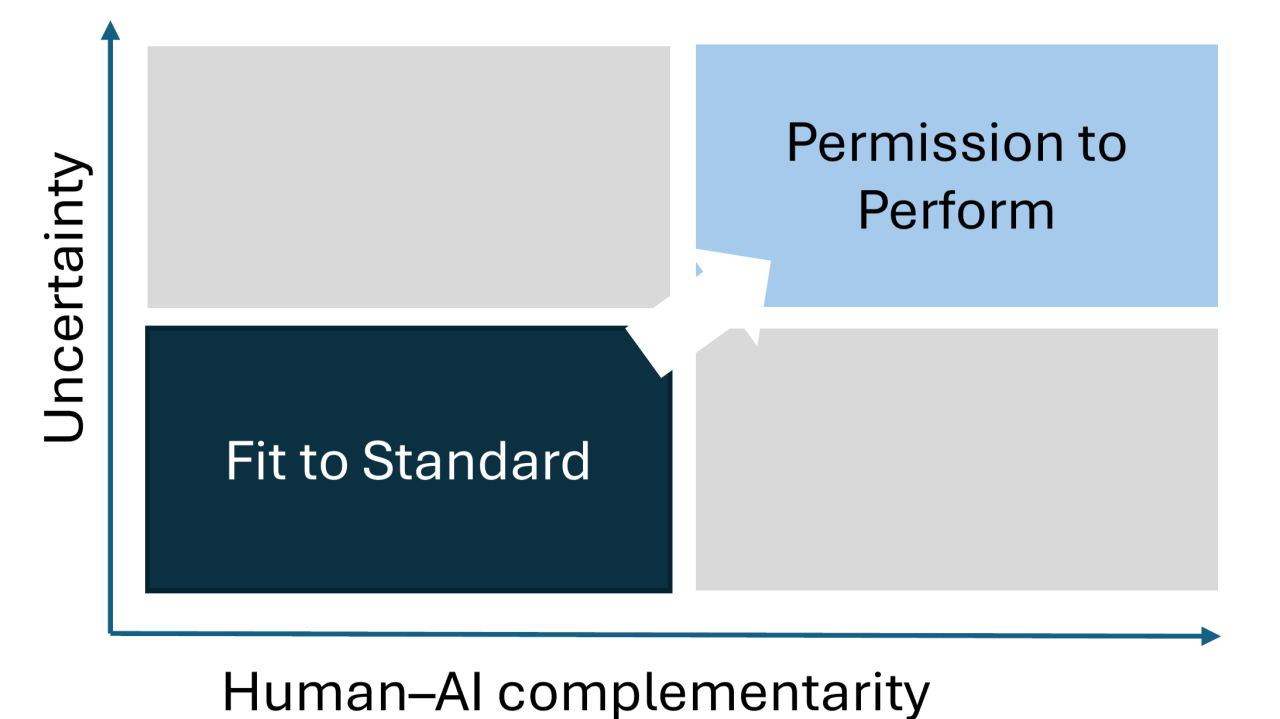
Across executive committees, artificial intelligence is raising two urgent questions: How should we adjust workforce size as automation advances? And how do we attract professionals capable of multiplying their productivity with AI?
Both are legitimate concerns, but they can conceal hidden assumptions, such as the belief that experienced employees are becoming expendable while the talent we need must come from a new generation of digital stars. What if some of that talent is already within our organizations, but our management systems are failing to recognize it?
Personalizing customers, standardizing employees
For more than fifteen years, digital platforms have used algorithms to personalize content and advertising based on individual behavioral patterns, demonstrating that differences between individuals can be accounted for at scale.
Yet we have learned to treat customers as individuals while continuing to train, evaluate, and organize employees according to standardized models.
From Fit-to-Standard to human uniqueness
For decades, the Fit-to-Standard model, defining roles, competencies, and processes, then selecting people to fit them, helped organizations achieve scale, efficiency, and control.
As AI takes on more repeatable tasks, however, differentiation increasingly depends on decisions made under uncertainty, with incomplete information and contextual factors that are difficult to document. Expert judgment and intuition developed through experience can contribute insights that AI systems do not always have access to.
Neuroscience and the knowledge gained from studying neurodiversity have helped us better understand how individual capabilities interact with working conditions. The lesson extends far beyond any particular group: every person brings a distinctive combination of abilities, experience, and ways of learning that standardized models may overlook.
Same objectives, different paths
Corporate AI training provides a useful illustration. A standardized program makes completion rates easy to track, but reveals much less about the capabilities participants actually develop. Allowing different learning speeds, sources, and practical applications, while maintaining common objectives and assessment criteria, can lead to better outcomes.
We call this approach Permission to Perform: flexibility in the means, rigor in the results.
Talent Engineering: building organizational intelligence
The challenge extends beyond individual performance. An organization does not necessarily become more intelligent simply because its employees become more productive. What matters is also how teams share knowledge, combine complementary capabilities, and make coordinated decisions.
Talent Engineering seeks to deliberately design these interactions between individuals, teams, and AI systems to strengthen intelligence across the organization.
Before deciding which talent to replace or recruit, leaders should ask what intelligence they risk losing and how to multiply what they already have. In the age of AI, competition will not be between humans and machines, but between organizations that know how to combine human and artificial intelligence more effectively.